Capstone · Cybersecurity ML
Hybrid ML Intrusion Detection.
A real-time hybrid intrusion detection system that runs an ensemble of ML models over network traffic and maps every alert to MITRE ATT&CK.
Challenge
Signature-based tools miss novel attacks, and SOC analysts drown in alerts with no context about what an attacker is actually doing. The job was a detector that catches unknown behaviour and tells the analyst what it means.
Approach
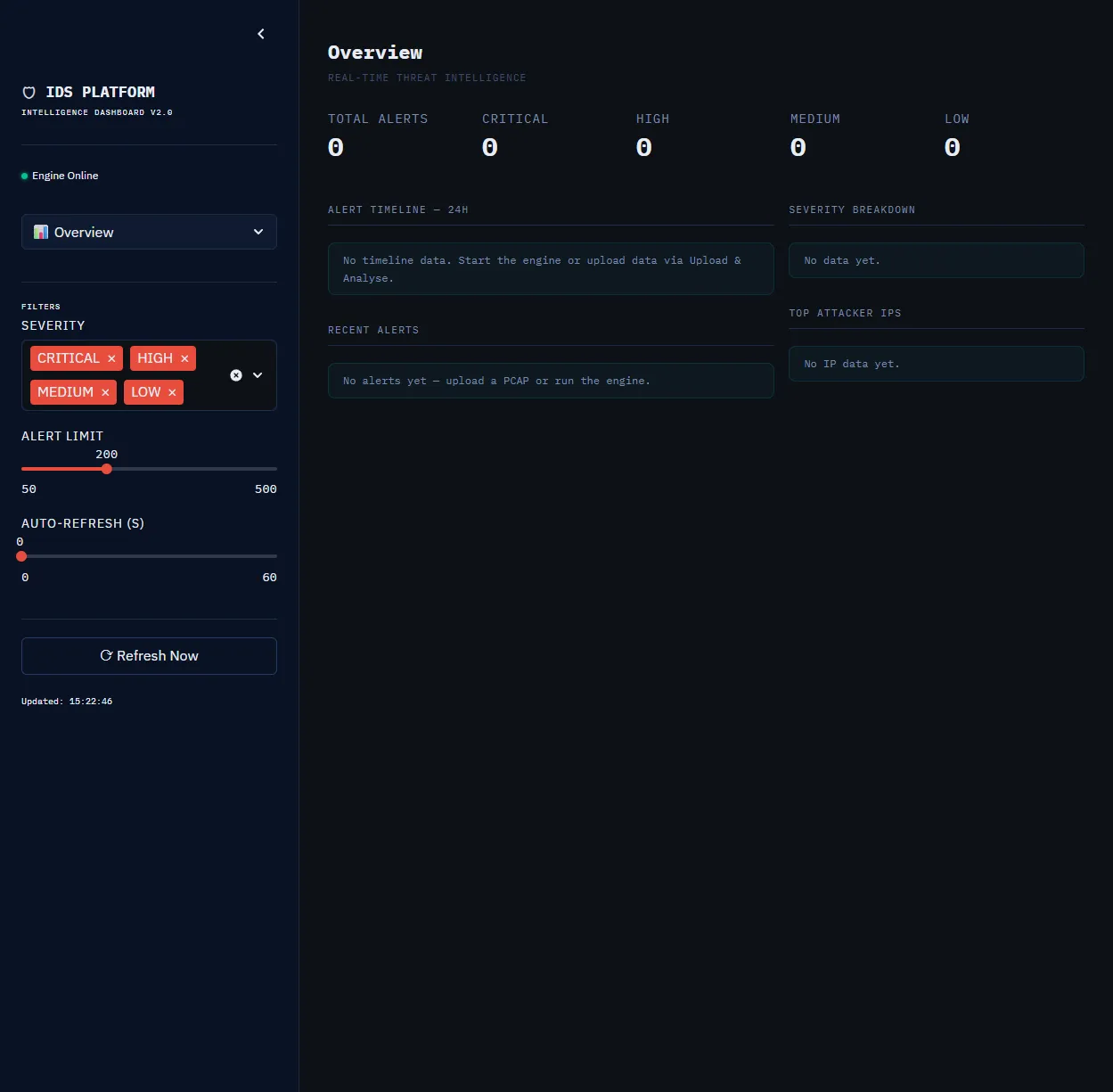
A hybrid NIDS and HIDS that runs an Isolation Forest, Random Forest and Autoencoder ensemble over CICIDS2017 traffic, with a real-time Streamlit dashboard. Live packet capture runs through Scapy; every alert is mapped to its MITRE ATT&CK technique so the analyst sees intent, not just a flag.
Outcome
Detects DDoS, brute force, port scans, web attacks, infiltration and botnet activity across the CICIDS2017 categories. The ATT&CK mapping turns each alert from a raw flag into a triage decision in seconds. Deployed live on Hugging Face Spaces with full source on GitHub.
Key decisions
- Ensemble of three complementary models: Isolation Forest for unsupervised anomalies, Random Forest for known classes, Autoencoder for reconstruction-error outliers.
- Every detection is mapped to a MITRE ATT&CK technique, so an alert reads as attacker intent rather than a bare label.
- Live packet capture and feature extraction with Scapy feeding the models in real time.
- Containerised with Docker and shipped as an interactive Streamlit dashboard anyone can run.